-
Unplugging; Brands; impact and film and more news.
- Posted on 1st Aug
- Category: Newsletter
Well folks, “below the fold” is the news for this week – and for awhile. As my longer-term readers know, I take every August off for a writing and social media vacation. Every year since 2010, which means for ten years now (!!!), I’ve unplugged from the web – except for work – for the entire month. I don’t check blogs, read any online news, f-around with Instagram, Facebook, Twitter, or any other social media. I am not lucky enough to be able to completely unplug – I do take emails from clients and other general work for the first two weeks of August, but then I actually stop checking emails for the latter half of the month and am completely off-line through Labor Day.
It’s the best thing I’ve ever done. And it’s led me to decrease my time on Facebook and lave Twitter completely; and I barely use Instagram anymore, even outside of August. I go on every now and then to post this newsletter, and to do some client work, but I don’t check updates or get lost in the endless scroll. About a year ago, I decided that even if I was staring at the wall, that was better than scrolling the feed. I was more likely to think a creative thought, or not have a negative one, if I just avoid the herd online. And you know what – I haven’t missed any important news, just some baby photos. I’ve taken that extra time on my hands to write – here at this newsletter, and in my own creative writing, and I am much happier for it, and the feedback and subscriber rates have been much improved here as a result.
I highly recommend considering a social media/online sabbatical for everyone. We’re all too connected to our phones, to the feed, to news on what crap Trump has done today, to what everyone thinks about it, and to “keeping up” with all the news in our industry (whatever your industry may be). It’s not healthy.
Or more poetically – here’s Kate Tempest on this same subject on her new album, The Book of Traps and Lessons (which I highly recommend):
“Stroke the phone screen with your thumb like
A mother
Trying to wipe clean the face of her only
Child
That blemish that black dot that will not come
Clean
The first sign of the
Plague
Absorb the ache of all your
Friends
And sleep with the light in your brain burning
UV all night”The D-Word, a great online documentary community board, has a special topic running on mental health and filmmakers right now. I’m not reading it – because I stopped participating in bulletin boards and email lists ten years ago as well - but I hear it’s going pretty well. If you must connect this August, I recommend perusing the comments and advice being given over there.
In the meantime, I’ll be swimming. I do this almost every day throughout the year, but focus on getting in more laps during August (most years, I even do an open-water race, but not this year). I picked it up again around the time I started my August internet sabbaticals, and it’s been great for my health – especially my mental health.
This weekend, the NYT ran an Op-Ed by a psychiatrist about what he’s learned about life and happiness from swimming, and it resonated for me. He writes about how he was always disappointed that he couldn’t swim faster, until his coach told him to focus on technique and the speed would follow. As Dr. Richard Friedman wrote in the NYT, “We all wanted to swim faster and the more hysterically we tried, the more speed escaped us. The same goes for happiness. Everyone wants to be happy, yet the more directly we pursue happiness, the more elusive it becomes.”
I think many people use social media and obsessively search the net, in some elusive search for happiness and meaning, and all it does is make you obsessed with the scroll, when happiness and meaning is all around you – if you stop searching for it, and just get offline and actually live. I need to do this more, still, but August is where I focus on this technique. Friedman concludes, and I will to, as follows: “In the end, happiness is a side effect of living well — just like speed can be the result of excellent swimming technique. Now, if you’ll excuse me, I’m off to the pool.”

WHAT I’M READING: FILM & STREAMING
Chinese vertical dramas made for phone viewing show the future of mobile video - (h/t Sundance Creative Distribution): China is always light-years ahead of us in the US on tech trends, and we see it here again with the adoption of more vertical formats for scripted shows, meant for viewing on mobile. With consumers switching from TV screens to mobile, this trend will continue. Quibi is going full bore with this as well, reports Digiday – they are requiring producers to shoot twice as much footage, so they can deliver every program in both vertical and horizontal formats. I know my auteur friends are puking now, but this trend might be here to stay. I say “might-be” because I hear a rumor that PornHub hasn’t adopted this format, and porn always leads the way for online video.
Average US Time spent with Mobile in 2019 Has Increased - EMarketer, in a report from June, shows that time on mobile now surpasses time on TV for the first time ever - a pretty significant screen shift.
How Netflix is changing the future of Movie Theatres - “Theatres have to fight against Netflix by becoming more like Netflix” says Forbes, with a good run-down of the bigger theater chain’s subscription plans, and how they might use the data they can now access for smarter movie marketing.
BITE ME: End of the Road for the Joyful Vampire Tour, On August 5th the Joyful Vampire tour comes to NYC, it’s the end of their multi-city DIY distribution tour, and the promise to share the numbers, be transparent, teach some lessons-learned about film distribution and have a party. I’m late to this particular show, but Ben in my office sent me these screen-shots when the tour hit his social feed and after perusing their materials, I was impressed:


Every few years some plucky filmmakers make a film that doesn’t get picked up and decide to go on tour. The late Sarah Jacobson did this with Mary Jane’s Not a Virgin Anymore back in 1997, and these filmmakers are following in her footsteps. It’s a lot of work to put together a film tour, but sometimes, it’s your only viable option.
You can watch their docu-series about the tour here, and the trailer is here. I have no idea if the film is any good, but I applaud their efforts.
WHAT I’M READING & THINKING: BRANDED CONTENT
This week was BrandStorytelling’s Elevate Conference. You can get a taste of what takes place by reading their newsletter, online here. The team puts on one of the best events I’ve ever attended, and if you are remotely working in this sector, it should be on your to-do list.

A lot of the conference topics are about learning who is doing what, discovering some new ideas and best practices. But there was a big emphasis this year on impact entertainment – brands trying to make a difference via social impact media, and how to do that. Another hot topic was measurement – most people there don’t even trust the viewership data they are getting, don’t know what other metrics they should be looking into and there’s a general consensus that some standardization needs to take place. There was a bit of future-casting – looking into what’s next, what we’re missing and what new forms story-telling might take.
Another much talked-about event was an inspiring interview with Debbie Sterling the founder of GoldieBlox. I am not in the demographic, but if you want to be inspired, you’d be hard-pressed to find a better story than how she defied all the naysayers and built a smart toy/tool to stimulate STEM interest among young girls, and “disrupt the pink aisle.” Starting with a successful Kickstarter, then hard work and brand building and later, some investment, she’s made a super successful brand.
But that wasn’t enough – as she sought to move into content, she took meetings with every studio, agency and broadcaster and they all turned her down. So once again, she and her team took destiny into their own hands and started what has become a super popular online video brand, with a GoldieBlox character, that has built a large and loyal audience of young girls who love STEM topics. I go into this for so long here because it’s a lesson for any filmmaker or aspiring entrepreneur, or brand going into content – don’t try to work with a system that isn’t built to try to help you. Break down the walls. As Mark Duplass has said – don’t wait for the cavalry to help you – you are the cavalry. Follow Sterling’s lead and just build cool shit and, if you do it right and get a little bit of luck – audiences will find you, with no one else’s help.
One thing that was not discussed, but kept coming into my mind – it’s been said that advertising is becoming a tax on the poor. Those who can afford it are paying for SVOD services and getting rid of interruptive advertising, but a large mass of people are telling surveyers that they want to pay less than $27 a month for their subscriptions, and for many, even much less – so they are moving to Ad-supported platforms (AVOD).
At the same time, there’s a huge war going on for eyeballs in the SVOD space, and that’s driving up costs for production and (in general) quality. Add to this the investments Quibi is making in the short form space (they will have both AVOD and SVOD options). What I see happening is a general raising of the bar, and that will mean that brands – and filmmakers – have to step up to another level in their budgets and quality to have any change of getting onto SVOD. And in many cases, those platforms will be very selective and curatorial.
So what happens if your brand wants to reach the “upper class” of consumers? Will you be priced or quality-filtered out of their feeds? And if you’re more broadly looking at the 90%, how does non-interruptive, quality content work in an AVOD environment, where those consumers reside? And where, um, it’s all about interruptive advertising, negating the reason to do this stuff. This is an upcoming dilemma that no one is talking about it, but I’m obsessed with the implications and where this might go.
Watching a presentation from WalMart’s Vudu – which is betting big on having the long-tail of content at a mix of transactional (paid) and AVOD (especially for their originals), as well as having shoppable content and very precise targeting based on your data (of which, they have a shit-ton) – and they are looking well-positioned for the future. They’re also pushing a curated content collection model that is very close to what I wrote about a couple of weeks ago. I never thought I’d say this, but Vudu is looking like a smart play for the future. Of course, this all represents another cultural bifurcation between the haves and have-nots and brands will have to think hard about where they want to reside in that world. Depressing/sobering to think about, so on to some better news.
Impact Entertainment matters to the C-Suite, according to a just released study by Participant Media, SoulPancake, BrandStorytelling and the Harris Poll. This was delivered at the Elevate conference, but Forbes has the summary as follows: “Top corporate marketing executives strongly support using film and TV programming to build awareness of their company's values, though the people who work under them are less certain about such an approach. And few say they know what to do next in harnessing Hollywood to push social positions that can reinforce their own brand's values.”

Shabnam Mogharabi. Photo from BrandStorytelling. The full study doesn’t seem to be online yet, but I’ll post it once it’s online (and when I’m back from that vacation). SoulPancake’s GM Shabnam Mogharabi made an excellent presentation at Elevate, and the results were pretty clear – the bosses want to make impact entertainment, but the lower-level marketing folks are afraid of pushing this too hard (quite a disconnect). Unfortunately, another finding showed that while brands said they don’t want to “purpose-wash” or “green-wash” their image, they’re still not valuing impact measurement as much as brand-lift and other old-fashioned marketing terms – meaning…well, purpose-washing. Regardless, the study gives us some data, can start some conversations and just might bring more brands to the impact entertainment arena (where I work, almost exclusively).
Why Marketers Should Care About Consumer Perception of Corporate Social Responsibility
From AdWeek: “What does this all mean for businesses? In today’s socially conscious environment, customers are willing to spend more of their money with businesses that prioritize corporate social responsibility. Improving CSR business practice and CSRPPQ not only help build a positive brand image, but also have a positive impact on improving customer loyalty and contributing directly to the bottom line.” Click on the link for some good examples. This coupled with the SoulPancake study made for feel-good reading in the brand space this week.
WHAT I’M READING: AI/VR/AR

Atari co-founder launches the first Alexa powered board game - a murder mystery called St. Noire, and it looks awesome. Oh yeah, it’s AI powered too. VentureBeat has the write-up on how it works (I am Alexa-less and can’t play it..yet):
“Players take on the role of a hard-boiled detective to solve a murder in the mysterious small town of St. Noire. Playing either with your friends as a team, or going solo, you will need to question a cast of colorful suspects, search for clues around town, and use all your deductive reasoning to suss out which character is lying to you.
St. Noire features multiple storylines and endings, immersive sound design, and cinematic voice performances via Amazon Alexa. To make sure no two games are alike, the identity of the killer is randomized on each playthrough, making every new game feel fresh and unpredictable. A full play-through may take 15 minutes to half-an-hour.”
This might not be just the future of gaming, but also of storytelling.
Amazon launches Prime video VR for Oculus GO, Quest, and Gear VR - Amazon launched a new store for 360 video. And Zuckerberg reported this week that they Facebook is sold out (temporarily) of the new Oculus Quest wireless goggles. Apparently, my boycotts of the technology are not working.
-

Diversifying the Cultural Conversation
- Posted on 7th Jul
- Category: Newsletter

NYT Op-Ed Page Elizabeth Méndez Berry (a director at the Nathan Cummings Foundation) and Chi-hui Yang (a program officer at the Ford Foundation) wrote a great Op-Ed for the NYT on July 5th about the need for more diversity among critics, cultural writers, editors (and assigning editors) in the arts and cultural sphere. The entire piece is required reading, but these two paragraphs sum it up for me:
This matters because culture is a battleground where some narratives win and others lose. Whether we believe someone should be locked in a cage or not is shaped by the stories we absorb about one another, and whether they’re disrupted or not. At a time when inequality and white supremacy are soaring, collective opinion is born at monuments, museums, screens and stages — well before it’s confirmed at the ballot box.
Yet those who have for decades been given the biggest platforms to interpret culture are white men. This means that the spaces in media where national mythologies are articulated, debated and affirmed are still largely segregated. The conversation about our collective imagination has the same blind spots as our political discourse.
I agree completely and I’m glad they’ve brought this discussion to a wider audience, and enlarged it beyond the usual conversation about the need for greater diversity in stories and storytellers. And its no criticism of the article to say the conversation needs to be broader still – as I’ve mentioned many times before here, in film alone, the ranks of film festival programmers and directors, arthouse theater owners and programmers, bookers, critics, acquisition executives and other decision makers are far too white and male. There are notable exceptions, but they remain exceptional examples.
As I’ve written before, many diverse filmmakers don’t even submit their works to certain premiere film festivals because they don’t feel those fests are “for” them. I know this is true, because many such emerging filmmakers have told me this. And I’ve seen numerous great films that have had a hard time getting accepted to these same fests because they don’t fit the taste profile of many of these programmers. They are then passed by (or never noticed) by acquisitions execs with the same taste profile. And if they do get their film distributed, they then face a crop of critics who may not be as in tune with their work. This isn’t only a problem for Diverse filmmakers/stories (and art), but for diversity (small d) of cultural style – there’s a sameness in what fest programmers like and critics like that leads to less diverse styles of storytelling as well.
Anyway, while the Op-Ed has been making the rounds and was in the NYT, go read it now if you haven’t. On to this week’s news.
Stuff I'm Reading: Film
I recently joined Josh Hyde on his American Filmmaker podcast to discuss indie film, branded content and a few other subjects. If you're interested, you can check it out here.
Will Chicken Soup for the Soul be the winner of the streaming wars? Holman Jenkins of the WSJ makes a good argument on its behalf, and while I don't always agree with this writer (and almost never with this paper's politics), he makes a good case. The company has a relatively new owner, Bill Rouhana, who used to run Winstar, and he bought the brand for the name - because brands matter online for curation, and this one "says 'nice';" and then he bought a big stake in Crackle from Sony. Oh, and he also got Popcornflix, and its 24 million app users in his deal.
He plans to use the ad-supported service to clean-up in the coming streaming wars. And I'll give Rouhana this - he gives a good quote to sum up the future: "The streaming war is going to be amazing,” he tells (Jenkins) “I can’t imagine how much money is going to be destroyed.”
That is true, and Rouhana's bet that people will turn to free, ad-supported streaming (FAST) is already panning out as consumers get tired of paying for multiple SVOD services. And he may do a better job curating and helping you find what you want, because as Jenkins points out: "He and his advertisers have a reason to care if somebody is really watching."
I always say that people need to focus more on curation. Well, both POV and Criterion are doing that pretty well in their email newsletters. Here's POV's from this week and here's one from Criterion. Figured I should praise as well as complain!
Quibi's line-up and mandate is becoming clearer, and the Hollywood Reporter has a comprehensive run-down of the execs and the shows:
AMC Theatres Launches Venture to Promote Small and Mid-Size Films - AMC is trying a new system to promote small to mid-sized films and give them more marketing, more time in the theater, and maybe a chance at finding an audience. They’ve tried this in the past, but maybe this time will work better?
Should journalists - and doc filmmakers - tone down the rhetoric and step outside the echo chamber in their reporting on climate catastrophe? Yes, argues Matthew Nisbit in a piece for Issues in Science & Technology reporting on the new Covering Climate Now initiative. It's a good piece, and I think anyone covering climate in their work, especially filmmakers, should take it to heart. While his focus is on journalism, his points remain relevant to doc films - mainly that scaring people and doomsday scenarios aren't necessarily helping things and we need more rigorous debate. He argues we need critically oriented science reporting ... to help maintain public faith in climate science and journalism.
How Darren Aronofsky and astronauts are taking on the environmental crisis - Both Arononofsky and David De Rothschild, a notable environmentalist, are pushing for less negative activist films, and more positive “As environmentalists, we’re undertakers of the wilderness,” de Rothschild says. “We tell you all the bad news. And bad news creates fear. And fear often creates paralysis.”
For HBO Max, streaming technology is anything but a commodity - the decision to leave Disney owned Bamtech and provide its own streaming technology has proven fruitful for HBO, having premiered the final season of Game of Thrones, without any major issues. Now, called HBO Max, they’re ready for prime time.

Lion King Comparison The dead-eyed new Lion King painfully illustrates the difference between cinema and video games – AV Club runs down all of the problems w/ the making of this movie. I haven’t seen it, but we all know these movies have been huge moneymakers for Disney and one of the seemingly surest bets at the box office. Let’s see whether audiences respond.
Stuff I'm Reading: Branded Content
I am teaching a short class on branded content at NYFA in Dumbo, Brooklyn on July 25th. Find all the details and register here.
Will more brands invest equity in feature films? Rick Parkhill of BrandStorytelling covers the story of Johnson & Johnson with 5B, and speculates that more brands may move into this space. Having a couple of clients who are already doing this, I suspect we'll see even more of it.

Sponsored Things Netflix’s ‘Stranger Things’ is dangerously close to becoming ‘Sponsored Things’ How much ‘New Coke’ and ‘Burger King’ did you spot?
Learn What YETI’s Head of Content Looks for in a Film- Among other things, he suggests concentrating on finding a good character, and then, make sure they “personify the brand.” I’ve worked with Scott and Yeti, and think they’re making good films, so check out his advice.
Cosmopolitan is launching a branded podcast with Tinder -
“Historically, branded podcasts have been a pricey purchase with real distribution challenges. While there have been success stories, such as GE’s “The Message,” or, more recently, a companion podcast to the HBO miniseries “Chernobyl,” which averaged 1 million downloads per episode, branded podcasts are typically not used to reach a large audience.
But as the podcast audience continues to grow, and as more legacy media companies get involved in the space, some may hope to leverage their reach to drive more scale than previously possible. “It’s a good option for certain companies,” said Steve Pratt, the founder of Pacific Content, a podcast agency that was acquired in May by the Canadian broadcaster Rogers Media. “For [brands] that want big reach or a mass audience, partnering with a media company makes sense.”
Verizon Media introduces media to branded content arm with immersive experience “In the fight for attention, brands need to become smarter in the way they craft their stories. By putting on a ‘show’ instead of a ‘tell’, we showed firsthand just how RYOT Studio is revolutionising the way content is created, communicated and distributed.”
The only magic of content is that it makes your brand disappear - moral of the story: great storytelling will lead to effective ads. No need for gimmicks.
Stuff I'm Reading: AR/VR/AI/ETC
The Pentagon Wants VR To Train for Nuclear War - scary, but another useful (but hopefully won’t be needed) application of VR
Using virtual reality could make you a better person - on a more positive note, maybe VR can help us become people who wouldn’t use nuclear weapons on each other.

The NBA just invested in this hot AI startup to train and find its next crop of global superstars - the NBA has developed an app that not only utilizes AI to evaluate basketball skill, but also create an online community of like minded people sharing a hobby.
“One of the most powerful things that we’ll see from this app is the community and the ability to have a platform that shares all the talent that’s out there connecting all those people, countries, and cultures.”
Offset, DJ Khaled, Russell Westbrook, and the brave new world of celebrity digital avatars - brands are starting to create celebrity avatars to help promote their products. One of the questions being raised is who ultimately will own these avatars, and how many will everyone have?
An Indonesian University Is Accepting YouTubers And Exempting Them From Entrance Exams - at first glance, seems like they’re pandering toward the younger generation. But they’re doing something similar to Colombia and their Orange economy, which is to help foster creative content to help bolster GDP.
Before VidCon, Facebook Tweaks Monetization Options for Content Creators - Facebook has launched some new features for content creators, and I like one of them a lot - fans can now buy bundles of “stars” to give to their favorite creators, who then accumulate real money and esteem. Note: As I was writing this, Youtube announced a similar program called "Super Stickers" at VidCon as well.
-

What does it mean when NYC loses Kanopy?
- Posted on 27th Jun
- Category: Newsletter

Big news in the educational streaming market this week - I may be the first person to ever type those words!- as the New York City Public Libraries Drop Kanopy’s “Free” Movie-Streaming Service. The NYPL, Queens and Brooklyn Public libraries all dropped the service (they are actually distinct library systems) citing costs. Now while many readers may not even know what the heck the educational streaming market is, I think this is bigger news - and worse news - than it seems.
Up until now, if you had a library card from these or many other public libraries, you could watch movies for “free” by just using your library card to access Kanopy, which has become one of the biggest streaming libraries for film in the educational marketplace. I scare quote the “free” part because Kanopy reportedly charges libraries about $2 per view (with a view being at least 30 seconds of watching), which adds up. In fact, these three libraries said the cost got too high for them to renew their contracts and would invest more into ebooks and audio books. Mind you, that’s what public libraries pay. Educational libraries, like a University or College, pay even more, with some quoting $150-300 once more than 3 people watch the film. For a good run-down of the educational market, Kanopy and how this all works, read this Film Quarterly article.
This is bigger news than it seems because those are three gigantic Kanopy clients. And Kanopy proved it when they flipped out - sending emails and communications directly to library users that, while couched in nice terms, were clearly trying to spark a mini-revolution among customers. If other libraries follow suit, it could be bad news for this new player, and for the educational ecosystem. And that’s bad news for fans of arthouse films who use the service, but also for filmmakers and distributors, especially doc filmmakers, who rely on educational sales/rental income to make up a not insignificant portion of their overall revenues. In fact, for some smaller films, the educational market is their primary income stream. And for even bigger arthouse films, it’s a meaningful revenue stream.
A closer look at the math is kinda interesting. Variety reported: “According to the New York Public Library, about 25,000 of its patrons (around 1% percent of the system’s 2 million cardholders) used Kanopy. The Queens Public Library said only about 6,000 of its 1 million cardholders used the service and that Kanopy was planning to raise the subscription rate to about $125,000 annually.” So while $2 per movie sounds cheap, it was adding up for the libraries.
But the numbers are an even scarier harbinger of bad news for arthouse films to me - just 1.25% of NYPL users, and just 0.6% (barely half of a percent) of Queens library users bothered to watch movies on Kanopy. And using the Queen’s numbers, they had about 62,500 views among 6,000 viewers, or just an average of 10 movies per user annually - and this in one of the hottest markets for indie and arthouse films in the US - and for “free.”
Granted, these aren’t the most scientifically accurate numbers or analyses here, but the simple math shows not a lot of demand for arthouse films. And this is presumably among the 25% of the more culturally curious NYC residents who have a library card and presumably read a lot and would be our target audience (approximately 25% of NYC’s population has a library card). To really analyze this, we’d need to compare it to their other subscription rates, etc. but I don’t see the numbers getting much more impressive. As the NYPL said on its own site: “our resources are better utilized purchasing more in-demand collections.” Ouch.
So we have a situation where too few people want the service, $2 bucks a pop is considered too much for some of the better funded customers in the country to afford, and where many other public libraries could follow this lead and make the same decision. And given that the library is often where younger audiences often first encounter this media, the lost opportunities are pretty scary. Yes, libraries have some other options and can still buy DVDs for awhile, but if the libraries of New York aren’t seeing enough demand to justify the cost, and Kanopy can’t make the business model more affordable, things look grim for the future of any streaming service focused on niche films, or their fans.
WHAT I"M READING: FILM

Hollywood and Madison Avenue both have a problem - they need to work with more women behind the camera - directors particularly, but also in other positions. Well, Alma Har'el has a plan to "flip the script" and the LA Times has the article on her new venture, Free the Work, “a global network for women and underrepresented creators and the people who hire them.” Read the article to learn more about the project and how to get involved.
FastCompany has some questions about Netflix’s massive ‘Murder Mystery’ viewership numbers - Numbers netlix released regarding Murder Mystery imply a 120 Million dollar opening weekend. Many are skeptical and continue to call into question Netflix’s metrics for measuring viewership. Me: It doesn’t matter. We’ve built an entire system around knowing these numbers, but they only matter to advertisers. And stars. But stars know their market value and can still negotiate the rates they want. Nonissue.
7 FREE STREAMING SERVICES TO SAVE YOU FROM SUBSCRIPTION HELL - With Kanopy leaving New York and many more streaming services ready to take its place for a fee, Wired lists some free services one can use,and their list is: IMDB TV; The ROKU Channel; Tubi; Pluto TV; Crackle; Vudu; (You may notice that there’s only six. The one I left out, of course being Kanopy).
Disney Pushing To “Significantly” Expand Hulu’s Original Programming, Says CEO Randy Freer Hulu is stepping up its original content game, according to TubeFilter and the Information. And Disney is also saying that most future programming will have to be made by Disney owned studios, or be co-produced by a Disney brand, and “how much production support Disney will provide in exchange for that co-producer credit isn’t clear.”
Bob Iger tells Barron's that Disney+ is not about competing with Netflix: "We’re not launching Disney+ to catch up to Netflix or even compete with them. The marketplace is hungry for this, and we have a brand people know and love." And as Evan Shapiro said on LinkedIn - that's smart:

Discovery Can pay it’s CEO a shit-ton, but won’t pay unscripted producers up front anymore - which is causing some panic attacks in the film-adjacent world. Deadline has the report. I’ve heard reports of producers having trouble getting financing for Netflix series, and now Discovery will become tougher as well.
WHAT I"M READING: BRANDED CONTENT

Advertisers wish Netflix would bring on the ads, but Sarandos isn't stupid - Digiday reports that advertisers can't shut up about how much they really wish Netflix had ads, and they use a lot of good arguments for why it should have them, mainly by pointing to the balance sheet. But the balance sheet doesn't reflect consumer love or hate, and sorry folks, but consumers/audiences hate ads. And Ted Sarandos knows that - as reported in Deadline, he told the audience at SeriesFest in Denver - "the company has no plans to incorporate advertising (a subject of mounting speculation) or bid on live sports. Both are “not core to the proposition” of Netflix." Good branded content, maybe. Ads - not if they want to keep up paying subscribers. Sure, AVOD has a place- with people who can't afford to pay (ads are a tax on the poor now, of course, but that's a longer story).
Samuel Scott at The Drum had a scathing op-ed on the hypocrisy of brand purpose marketing at Cannes Lions. His argument is that no one is walking the talk, and especially when it comes to having an impact on environmental issues. He argues it helps more with employee recruitment than actual impact. I don't agree 100%, but he's right about a lot of this, and it's worth a read and a think.
Why does Content matter? - Lynn Browne (Co Founder of Brand Verge) lists why Branded Content is ultimately more effective than traditional advertising.
YouTube's Sataya Raghavan tells brands how to optimise their Branded Content - The director of YouTube partnerships in India further argues that Branded Content is helping brands stay relevant and reach more audiences.
Colombia wants to be known for its creative economy even more than its coffee - Colombian President Ivan Duque was at Cannes Lions where he’s pushing his “Orange Agenda,” which involves heavily funding and supporting the arts and creative industries. I can’t wait to hear what locals think when I am in Bogota in two weeks for the BAM Bogota Market, but I like the sound of this:
“We’re talking about a sector where you have festivals, carnivals, gastronomy, museums, visual arts, live arts, media, TV, movies, digital, advertising, marketing, gaming, jewelry. You add up all those sectors in a country like Colombia, its contribution to the economy is double the size of coffee and even bigger than mining,” said Duque, which garnered enthusiastic applause from the Cannes crowd at his session. “So we have to help people understand that when we’re talking about the creative industries, when we’re talking about talent and innovation, we’re talking about a very vibrant and important force to change our nation.” (President Duque)
WHAT I"M READING: INTERNET/OTHER
Cory Doctorow wrote an "op-ed" from the future for the NYT, where he speculates on the damage done when we give too much power to a few internet companies, and crack down on free speech in service of ending "harassment, extremism or disinformation" Which doesn't work, of course. Worth a read for why we should pay more attention to the poor policies being considered in the tech space.
-
Netflix’s “Ad-Free” Experience and the Future of Branded Content?
- Posted on 25th Jun
- Category: Newsletter
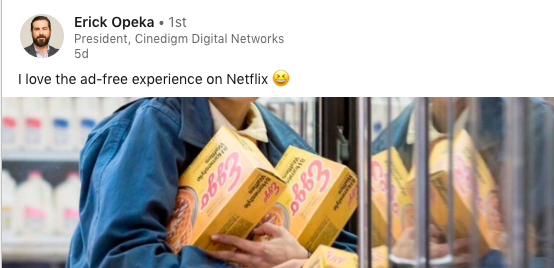
Erick Opeka got a few laughs on LinkedIn when he posted this comment recently:

I’ve long argued that Netflix is going about brands and content in the wrong way- product placement like this, or these gigantic ads for Lavazza Coffee on Comedians in Cars Getting Coffee are actually more intrusive and gross than regular advertising. Heck, on the new season of Comedians… Seinfeld takes us on a five minute gushing tribute to Porsche that is longer than any commercial.

Aside from the few times when it makes legitimate sense to show a product for nostalgic reasons (and some of the Stranger Things tie-ins fall into this category), Netflix should move away from product placement and embrace smarter branded content. With nearly every brand you can think of making films these days, and all of them needing distribution, it’s a great opportunity for Netflix to get good content, lower its bills and bring in a new revenue stream without ruining the consumer experience.

Of course, this is dependent on maintaining its curatorial eye – use the humans at Netflix and the algorithm’s both to make sure that what you are licensing is entertaining (or enlightening, or otherwise valuable) to audiences. You can’t just start showing every crappy brand’s video, even if it wins a Cannes Lions (which are no arbiter of quality). But there are plenty of good branded content films/series out there, and many more in the pipeline and it’s astounding to me that Netflix isn’t pursuing this more aggressively.

Plus it gives them a marketing partner for each piece of content that often negates the need for a theatrical release – or when a theatrical is warranted, helps guarantee butts in seats through the extra marketing power of the brand partners. Yes, product placement does this too, but it’s much more advertising-oriented (and usually gross) than a simple logo at the beginning of the film, as most branded content is currently practiced.

FastCompany just ran a report about the product placement on Netflix, and points out that Netflix is pointing out that it didn’t accept payment for these placements. They’re clearly feeling a bit beat-up from the negative attention (there are gazillions of anti-product-placement stories online right now). Well-made branded content would negate this crap while expanding a smarter partnership structure.
Analysts keep writing stories predicting that Netflix will have to launch advertising, or an AVOD solution, to make up for slowing subscriber growth and to lower their debt. I don’t see this ever happening, as it makes for a poor customer experience. But switching from product placement to good brand relationships (and payments) via curated branded content would make for a much better option.
I’ll go a step further into (maybe) crazy-land and suggest that just as Netflix has upended the field of media, it can disrupt advertising for the better as well. If Netflix did this the right way – which would mean being super-selective, making brands work with trusted, quality producers directly (instead of with agencies) and with the real budgets it takes to make quality films/shows – then we could shift a lot of energy out of interruptive advertising and into quality content people want to watch. It would solve an actual consumer problem – wanting to skip ads – and a business one- wanting to break through the noise and reach those consumers skipping their ads – and an existential one – that it increasingly looks like content divorced from another profitable business is unsustainable.
I’m sure my leftist comrades are appalled at the thought of even more content being swayed by corporate interests. And this is a very real concern,. But it’s one we’re stuck with anyway, and one of the antidotes to that is better public support of media via a revamped approach – which could even mean requiring space for public media on Netflix – but that’s another article. Trust me – I am not arguing that we should only have branded content. That would suck (and be very much like the major networks anyway).
I’m just arguing that Netflix could do things better, and possibly disrupt a system (advertising) that is too busy taking micro-steps instead of making reach change.
WHAT I’M READING: FILM
Media’s Blame Game – AKA how not to do branded content, or media – This one from Om Malik (Founder of Gigagom) is making the rounds and it’s a good piece to keep in mind when contemplating my proposal above, as it shows how brands and their ads are slowly destroying our media. Well, that and a lack of planning or innovation on the part of media companies. It’s the must-read of the week.
The Doc Life: So What Exactly Does Successful Distribution Look Like? – When I go to film fests and talk to industry, one of the smartest voices in the room is always Tim Horsburgh, Director of Communications and Distribution at Kartemquin Films. Check out this interview with Film Independent, where he discusses the difficulties of film distribution.
Netflix is in the news nonstop: Here’s why Netflix says it lost US paid subscribers for the first time in eight years. And in other news, Netflix launched a mobile-only streaming plan in India for less than $3 per month, and some people think it’s a test-case for a similar service in the works for the world.
THE STREAMING WARS are heating up, and multiple publications weigh in:
The Financial Times warns that we are heading toward over saturation. SF Gate offers a list and breaks down the numerous services that will be available. (Spoiler: There’s too many). Forbes suggests that investors shouldn’t just look out for streaming dominance, but rather what companies are making smaller, but more innovative steps in the technology, and thereby lead the next media revolution (hint, this is the smartest take here). Yahoo Finance breaks down how Amazon and Disney will be the lead challengers of Netflix. And for some counter-argument, The Verge weighs in on Plex, which makes piracy a streaming service. They correctly note that the rise in piracy further reflects that it is getting too hard and expensive for consumers to watch what they want.
The Booming Podcast Business: Why Do You Listen? – I don’t know, because I don’t. But I know everyone else does.
And last, a plug for a great new film that I highly recommend, from a filmmaker I admire, and my friend, Rodney Evans: VISION PORTRAITS is a deeply personal documentary by award-winning filmmaker Rodney Evans (Brother to Brother) as he explores how his loss of vision may impact his creative future, and what it means to be a blind or visually impaired creative artist. It’s a celebration of the possibilities of art created by a Manhattan photographer (John Dugdale), a Bronx-based dancer (East Texas native Kayla Hamilton), a Canadian writer (Ryan Knighton) and the filmmaker himself, who each experience varying degrees of visual impairment. Using archival material alongside new illuminating interviews and observational footage of the artists at work, Evans has created a tantalizing meditation on blindness and creativity, a sensual work that opens our minds to new possibilities.
Opens August 9th in NYC at Metrograph
Opens August 23rd in LA at Laemmle Royal
WHAT I’M READING: BRANDED CONTENT
Quibi Acquires First News Program In Reported 8-Figure Deal With NBC - more Quibi news. The smart move here – Quibi shows that like Netflix, it is battling not to be just another service (here, on your phone), but an entire eco-system of content, so you don’t need to go anywhere else.
No, Your Brand Newsroom Is Not Really a ‘Newsroom’—and That Is OK - Another example of how creators making branded content need to embrace what branded content actually is rather than what they think it should be.
Olivia Munn is starring in a new cybersecurity thriller about the Sony hack . . . for IT managers? - Covering a dull subject for branded content? Just get a celebrity involved. Lenovo uses the woes of another company’s hack (Sony) to push its own cyber-security. Will be interesting to see whether this works.
Will GAIL’s ‘Hawa Badlo’ campaign shatter the branded content ceiling - Brand Equity brings up how we don’t have an effective way of measuring branded content impact.
People are reacting more to branded posts from Influencers than their own “normal” posts. What the heck? But it seems true. Instagram claims it’s not their algorithm just pushing branded posts, but call me skeptical. The writer points out that perhaps “influencers are actually putting in more work to create high-quality content for their ad partners than they do for their own content.” Whatever the reason, that’s good for the cart. If more people are interacting with branded posts, they might do more shopping as well. Then again, as the writer for FastCompany points out: “Influencers are competing for our mindshare in the extremely limited funnel of our feeds. As a result, everyone we follow seems to be selling us something all the time—even when they actually have more to say.”
-
Missing the Boat on Curation
- Posted on 21st Jun
- Category: Newsletter

Every brand is now a studio. Every day, a new brand enters the fray of content creation. They all want to be filmmakers. And I obviously think that’s a good idea in general, or I wouldn’t advise brands on how to do it, smarter. But at a time of superabundance, when the last thing the world needs is another movie, smart brands should be thinking more about curation than creation.
Mind you, I didn’t say every brand. People trust certain brands and not others, and curation only works when there’s trust involved. But for those brands that have built such trust and have the following to prove it – there’s a unique opportunity, and a glaring gap in the market for smart curation.
As I mentioned a couple of weeks ago, Joe Marchese wrote about curation and the attention economy for Redef recently, and pointed out: “…The brands, retailers, and media companies that understand how to operate in the current Attention Economy will become trusted curators and shape the future of culture and commerce.” (emphasis mine).
You don’t even have to stop making films. Yes, they are sexy to make. But that’s also why everyone else is making them too. The argument today is really - why make content, when you can help me find it instead? I have thousands of options to choose from, and my feed is cluttered with too much stuff already. What I need help with is finding the best stuff to watch (and yes, you guessed it, curation can work beyond film, but let’s keep the focus narrow for now). The real reason I hate ads is because they interrupt me after I already just spent half an hour trying to find something worth watching. But I’d gladly watch your ad, or become an even more loyal brand follower if you helped me find the best stuff to watch without feeding me more ads.
In fact, I’d subscribe to your channel if you’ve curated the best content for me – even in this era of too many services, because what consumers want/need is better curation, not just a better selection. I’m surprised that the only brands to have launched subscription (and AVOD) services have been retailers like WalMart. Sure, that makes sense because they do sell things. But those retailers don’t have my trust. I’m pretty sure we’ll see curation services if not SVOD services soon from celebrity brands – Goop Video, for example. But there’s a couple of handful of brands that have that same trust, and they should move into this space fast.
The easiest way into it would be via partnerships – partnering with platforms to curate content. This could easily be done on Netflix or with publishers like the NYT – all of whom are slowly coming around to better brand relationships. But over time, curatorial brands should be platform agnostic, and indeed part of their power comes from being able to recommend great programming across platforms. I can barely remember which platform has my favorite shows anymore, but I’d use a curatorial app from a trusted brand to remember those and discover new content at the same time.
But curation shouldn’t just be about picking movies/shows for me to watch – it should also include content “around” films/shows - guides to films, articles on why they’ve been selected, links for digging deeper, and over time, perhaps live or originals as well - tours, Q&A’s with filmmakers, and more.
There’s a lot of opportunity here, and it’s time for some brands to take ownership of this space.
WHAT I'M READING: FILM & STREAMING
Apple Plans on Releasing Six Movies a Year For Oscar Consideration - According to the SlashFilm and others, Apple plans on financing “six small-budget movies a year with an eye toward stories that could win Academy Awards.” That’s good news for filmmakers and fans – quality over quantity.
Amazon is rolling out and IMDB streaming service that will be free (with ad support). At the same time, Amazon's Increasing Its Ad-Supported Streaming Video Investment. Amazon will let you watch films how you want – subscription (SVOD/Prime), for sale/rent (VOD) or free/ad-supported (AVOD) meaning they hit all potential consumers. Smart moves.
How Do You Build an Anti-Capitalist Streaming Site? - Nick Hayes and Naomi Burton, founders of the Detroit-based leftist media company Means Media, talk about their ambitions for Means TV, a worker-owned, completely viewer-supported streaming platform. They’ve made some great campaign videos, now let’s see if they can make this work.
3 Reasons Amazon Prime Video Will Survive the Streaming Wars. Other than just being Amazon, there are a few other reasons, go figure.
Amy Dotson gave a hell of a going away speech as she leaves IFP and heads to Portland. Filmmaker Magazine has the speech from BAM CinemaFest. IFP was too dumb to keep her, so she's blowing things up and starting a new career elsewhere. Onwards! NYC's loss and Portland's gain.
WarnerMedia May Price Its Streaming Service Higher Than Netflix. Why? – Motley Fool argues that with a library that may rival Netflix in size and that the switch over to 4k among media will cause prices hikes among all the streaming services. They may just be ahead of the curve. Of course, everyone’s always said that no one can make money at the prices Netflix has been charging (thus why they chose said prices). But it’s also a big gamble when consumers have so many options.
Quibi has sold a lot of ads, as Variety reports. They have two tiers – and ad supported and ad free, but both have a subscription fee. But Madison Ave is ponying up to be part of the experience. No surprise there, as this is a solution built for Hollywood and Advertisers. I’ve written about it before, and I’ve also got an editorial in the new Filmmaker Magazine about it. It’s behind their premium paywall right now, but this is also a chance for me to plug that Filmmaker Magazine is one of the few publications worth your dime – subscribe now and read what I have to say about the pros and cons of Quibi, as well as many other great articles on the business/creativity of film.
WHAT I'M READING: VR/AR/AI
‘There’s Just No Doubt That It Will Change the World’: David Chalmers on V.R. and A.I. - Philosopher David Chalmers give his take on how V.R and A.I will affect the future for the NYT. He’s a smart one, and his thoughts on how Artificial General Intelligence (AGI) will change consciousness and more – luckily he sees it as more like 40-100 years away.
ARTISTS ARE USING VIRTUAL REALITY TO CONVEY THE PERILS OF CLIMATE CHANGE - At this year’s Venice Biennale, artists are using creative ways to drive home the urgency of climate change and sustainability. Let’s hope they have more impact than we’ve had via films.
VR is training cops to empathize with the people they may kill –if VR is an empathy machine (which I don’t believe, btw), then maybe this will help cut down on some bad situations.
WHAT I'M READING: BRANDED CONTENT
5B wins the Cannes Lions Entertainment Grand Prix. Congrats to producer Rupert Maconick & Saville Productions, UM Studios and Johnson & Johnson. 5B is the rare brand film that can play at the real Cannes - the film festival, in competition mind you - and then also win an award at the Cannes Lions. And it's because the film is great content, well made, by a great filmmaker - Dan Krauss. Kudos to all of the filmmakers/team.
Cannes Lions Takes Place in Time of Change for Ad World - Variety reports on how the ad world is changing - demonstrated by the presence of celebrities, showmanship, diversity and Apple - at Cannes Lions. A good run down of what’s going on.
Cannes Briefing: The scramble for the future of TV has begun – Digiday breaks down the trends at this year’s Cannes Lions, which seem to be all about the future of TV and as one unnamed exec put it: ““The challenge is always the same, trying to become or stay relevant for consumers in a world that’s more and more fragmented.”
Branded Content Campaigns Help Ads Cut Through Clutter - Variety again on branded content, and why more people are turning to it. Nothing new here, but it’s a good summary of what’s going on - “In an era of content overload, when it’s easier than ever for consumers to skip an ad or avoid it altogether, many advertisers are trying a different tack: branded content. Rather than traditional “interruption” advertising, they are creating content that people actually want to watch, tailored to the platforms on which they are viewing it.”
REI launches a Magazine and Support for Nonprofit News on the Outdoors: This is a client, but I had nothing to do with these two items- REI announced today what I think are two awesome moves - the launch of a new magazine, Uncommon Path, and investing in 10 local news orgs through NewsMatch to support local journalism on environmental issues and the outdoors. Kudos to the team.
-

Surviving the Trifecta Dash, Fake film fests, brain machine interfaces, new branded content and more
- Posted on 14th Jun
- Category: Newsletter
Surviving the Mad Dash to the Trifecta

via Hollywood Reporter This week’s newsletter opinion piece is shorter than usual because I’ve been participating in the June 14th Trifecta Mad Dash – hitting the deadlines for the Toronto (TIFF), Venice and Telluride Film Festivals, what is known in the film world as the Festival Trifecta.
While this is changing a bit as the three duke it out over premiere status rules, it used to be that you could premiere at all three festivals in September. This is the way it should be forever, and this fight is ridiculous; but in theory, you can still do this pending a few things about timing and type of film. Anyway, every producer with a film that is finishing soon is doing this same hustle this week because they may only get into one of them (or none of them) anyway, but you have to try. Technically, the Telluride deadline is not until July 1, but that’s not too far away, so aside from some last minute polishing, everyone is trying to get their rough cuts good enough for submission by the end of today.
I’m involved with several films that will be submitting – films I produced or from clients and/or friends who wanted feedback, and I have many producer, sales agent and distributor friends who are doing the same thing.
It’s insane. And then we all do it again for Sundance, and Berlin and Cannes and…. a few others. But there’s no getting around it – we can complain about premiere policies, but you gotta have a deadline somewhere and it will always be a mad rush alongside thousands of other films. For all the things that have changed in the film world, the deadline madness won’t go away, unless you decide to forgo festivals and just take your film out there (which some people do, even for big films). But in reality, these top festivals are definitely worth it for those lucky films that get accepted.
So good luck to all of you out there who are submitting to a festival this week, and I hope your real final cuts are even better than the ones you are submitting today. I promise to have something fancier to write about next time, but for now, I have some more films to submit.
WHAT I’M READING:
FILM:
Filmmakers Beware of Fake Film Festivals - and these are just two of many other scams out there.

A team at Stanford has built a pretty simple tool to seamlessly edit what someone says in a video, by just using a text editor, opening the door to both easier editing of flubbed lines/missing dialogue, but also lots of crazy faked videos. While the accompanying video is very academic, it seems to work flawlessly and is pretty fascinating. Meanwhile, we’ve seen other versions of this being used for disinformation already - the fake Pelosi and fake Zuckerberg, but this tech makes it even easier.
BRANDED CONTENT
Branded Content Initiatives Help News Publishers Rake In Revenue, But Some Remain Wary – A new study shows strong profit margins on branded content, especially for smaller, local news brands. It’s part of a new initiative to help save journalism, and that seems like a reason to keep experimenting.

Mailchimp is launching branded content. Mainly around small business and entrepreneurship. Welcome to the party. It’s crowded here. But they did pick some interesting folks to work with, so I am intrigued: director Jason Woliner (What We Do in the Shadows), writer Samin Nosrat (Salt Fat Acid Heat), actor Jay Duplass (Prospect), and actor/composer Big Boi (Someone Great).
Instagram Lets Advertisers Promote Branded Content From Another Channel - Retailers can now create ads using organic posts from other channels that have branded content. So now you can pay an influencer to show your brand, or just find someone promoting you for free, and then create an ad from that content and promote it further. Weird, but interesting. This could be useful for film promotions too.
11 Branded Content Innovators Who Take Marketing to the Next Level – Good list.
Brands like HP and Apple try film to reach young consumers who skip commercials - More and more brands are discovering that it is both cheaper and more effective to create branded content documentaries over commercials. Everyone has posted to this LAT story, but it’s worth a read if you somehow missed it.
Pop Culture Site Powering Through 4 Weeks Of Sponsored Posts For Movie Its Film Critic Called ‘Contemptible Trash’ Most important article of the week.
Twitch is emerging as a favorite new platform for publishers – It’s collaborative, it allows direct links for sales and it seems to be working. Why? The engaged fans.
VR/AR/AI
What Black Mirror Striking Vipers gets wrong about VR - In essence, we’re much further away from the technology in the story than the episode would imply. But hey, it’s the only good episode this season, so let’s give them some credit for that.

DARPA is now investing in brain-machine-interfaces (BMI) that doesn't require surgery - meaning brain control of artificial limbs or allowing "a single soldier to control swarms of AI-enabled drones with his or her mind." Or an actor to control a recreation of a deceased one for a new movie before long.
OTHER
Meeker Internet Report: Too Much Streaming, Not Enough Security - Venture capitalist Mary Meeker has this to say about the internet: the streaming bubble is going to pop. Her 300 slide reports are a must read every year, but this article gives you the ten bullet point takeaways if you’re in a rush.
Apple Arcade is poised to make Apple the ‘art house’ gaming platform - and by doing so its choosing not to compete with the big gaming companies (Microsoft, Sony, and Nintendo) and instead carve their own niche within the gaming world. Smart move, Apple.
Can “Indie” Social Media Save Us? Let’s hope so, because I for one am done with the current crop. A good analysis of the IndieWeb – per the article: “Proponents of the IndieWeb offer a fairly straightforward analysis of our current social-media crisis. They frame it in terms of a single question: Who owns the servers? The bulk of our online activity takes places on servers owned by a small number of massive companies. Servers cost money to run. If you’re using a company’s servers without paying for the privilege, then that company must be finding other ways to “extract value” from you—and it’s that quest for large-scale value extraction, they argue, that leads directly to the crises of compromised privacy and engineered addictiveness with which we’re currently grappling.”
-
Getting inspiration from a teen filmmaker, and more news you can use for June
- Posted on 7th Jun
- Category: Newsletter

Burning Cane How a Teenaged First-Time Director Won Tribeca With His No-Budget Feature
Philip Youmans, a nineteen year old, wrote, shot and directed Burning Cane, a feature length film, which would go onto win the Founders Prize at Tribeca Film Fest. The idea first came to him as a sixteen year-old in junior-high school. NoFilmSchool has the full story and interview, and this is my pick for inspirational story of the week.
A few big take-aways from me -
1) he had a singular vision and was obsessed - every successful director I know is obsessed and won’t stop until they make their vision a reality. Youmans tells NoFilmSchool: "I've been making short films since I was in eighth grade. They were very bad in the beginning but I kept making more and more. I was getting better, learning about the things that didn't work. I learned through a lot of trial and error and put all of my money into my shorts growing up. That's why I didn't travel that much—I would put all of my money into the shorts. That, and gas for my car." That to me is the single biggest commonality I've found among successful filmmakers - whether you give them ten dollars or ten million dollars, they will spend every last cent of it making films, learning the craft, making mistakes and having break-throughs until they bring their vision to reality. Of course, the trick is marrying this to actual talent, but talent without obsession rarely goes this far.
2) he told a story that was native to his experience - the guy's a kid, what experience can he bring to film, some would ask? Well, read the interview - he knows his locale and focused on what he knew best. This was a story he could tell because he grew up right in the middle of it.
3) he had the gumption to reach out for help (to Benh Zeitlin no less) and that alone will help make his career. Sure, he got lucky here too, and actually got a response. But it was having the gumption to try - he didn't have any connections, he reached out via Instagram. Similarly to how Raymond Santana tweeted Ava DuVernay to get her interested in the story of the Central Park Five for When They See Us (which was partly his story), Youmans took a chance and it worked. He also relied on the help of his friends - as he says in the article, only your friends will help you make a low-budget film - "Friends are willing to stick through it with you even when things are incredibly uncertain" and that's true for any film, and any business endeavor.
Great coverage from NoFilmSchool - and a filmmaker we'll undoubtedly be hearing from again. Reading stories like this one renews my faith in indie film, and I hope it does the same for you.
WHAT I"M READING: FILM

Quibi: The next Go90, or streaming unicorn? - Quibi is setting out where other streaming platforms have failed: creating a mobile streaming platform. The differences: an executive all star team, backing by major studios, and rising trends in mobile consumption. But at the end of the day, will this only benefit major studios, or will it help Quibi to become a success as well? The debate continues on Digiday, who also report that Quibi has dropped plans for connected-apps, and is sticking with mobile only plans.
Amazon Brings Shows to Life to Stand Out in the Streaming Space Amazon is using multi media experiences to help promote their shows. Examples include The Garden of Delights, a sensory experience used to promote Good Omes at SXSW, and bringing back Carnegie Deli during the upfronts tp promote Marvelous Ms. Maisel. “
It's about going beyond the binge," said Callif. "How do you keep the conversation going with fans and get them not only excited and continuing with these properties, but also to hopefully be sharing it with their friends and family to get them engaged?"
Me: Transmedia storytelling is still at work, just under different names.
Video streaming apps go local for stories Upcoming Netflix originals such as 'Yeh Ballet' and 'Kaali Khuhi' will be based in small towns in India. With most OTT services needing relevant content to fuel their subscription-based models, “heartland stories” are forming a core content strategy, according to industry experts. In short, you can’t conquer a country without working with local storytellers. People want content that reflects their lives, and Netflix (and other SVODs) will have to invest a lot in local production to keep subscriber growth moving. Let’s just hope they work with some “true indies” along the way.
Youtube is changing how subscribers counts are displayed, possibly shifting its culture - While it seems like a small change, this could lead to big problems, especially as more attention is being paid to subscriber counts. I’m all for Instagram hiding like counts, so we stop obsessing over esteem, but the video business is a business, it’s not just social, and the last thing the video business needs is less transparency or “rounding errors.”
Cinelytic in the News – I’ve been following the development of Cinelytic for awhile now (it launched when I was helping run another data project, so we spoke a lot), and it’s up and running now and making some news. Check out this article in the Verge on how Cinelytic’s technology supports the business side of film. And also this interview with Fox Business News, where Cinelytic’s CEO, Tobias Queisser discusses their use of artificial intelligence to shake up the film industry. I think it’s a pretty smart tool for modeling potential film performance, and it’s worth using if you are a brand, platform or producer making a lot of narrative content (it doesn’t work for docs really).
WHAT I"M READING: BRANDED CONTENT
AI vs Curation and the Attention Economy- Joe Marchese is one of the smartest people in the business, and he recently left Fox to work in VC, with a focus on smart start-ups curating the future of media (among other things) He penned a nice article for Redef about the need for better systems for getting people’s attention than the crap AI systems we’ve built, which are focused on maximizing eyeballs cheaply for advertising (he calls it fracking for attention...nice one). As he says: “In effect, we have abdicated our responsibility for curating what is worthy of a fellow human’s attention to A.I. which, in turn, is optimizing only for immediate engagement and advertising margin.” And he makes a strong case for what’s needed: “However, the brands, retailers, and media companies that understand how to operate in the current Attention Economy will become trusted curators and shape the future of culture and commerce.” (emphasis mine). Read the full piece for what he thinks will work and how he’s working to build that future.
Film Independent held a Branded Content panel, and the takeaways are worth a read, and the full panel video is at the link. (h/t Sundance Creative Distribution newsletter). I take issue with the title - selling out vs. getting paid what you love to do, which perpetuates this myth that making branded content is somehow just about a paycheck - it can be creative in its own right, but the tips and feeback here are relatively solid.
How culpable are filmmakers who support frauds/bad companies in ads/branded content? - Hyperallergic has a good little article about Errol Morris’s work for Thernos (and AIG and Nike) and the ethical implications. Few people stop to think about the actual ethical implications (beyond the idea of “selling out,” so this is worth reading and contemplating for anyone thinking about this space.
BBC StoryWorks boss: Content marketing is advertising Jelana Li, head of BBC Storyworks AUNZ, rejects the idea that content marketing shouldn’t be viewed as advertising, but rather still carries the “function” of advertising,” which is to sell a product” “Consumers are very smart these days, they know when content contains a commercial message and if it’s not labelled as such, they feel betrayed,” Li says. Me: Amen. Part of being “authentic” with storytelling is acknowledging that any brand message is in some manner an advertisement. Even if your true KPI is societal change, or something else, your brand value increases (when this is done well) by the affinity with a good story, and no one is fooled by this. And if they are, they’ll be even more pissed off when they find out the truth. So be up front about it.

NorthFace-Pedia[/caption]Why The North Face manipulating Wikipedia confirms our darkest fears of advertising - Another slap your face moment in brand mishaps this past week - The North Face and its Brazilian agency Leo Burnett Tailor Made boasted about how the brand evaded Wikipedia editors to slyly embed the outdoor apparel giant’s products in high-traffic tourism pages for sites like Peru’s Huayna Picchu, Brazil’s Guarita State Park, and Scotland’s Isle of Skye. Wikipedia immediately called out The North Face in a Twitter thread, accusing the brand of lying about collaborating with the platform. Remember, authenticity is a buzzword for a reason.
Indigenous Media uses 60 Second Docs to Carve out a niche in the branded content world - Jake Avnett (CEO of Idigenous Media) is able to push strong branded content in a digital medium through film conventions. This is made apparent through the success of 60 second docs. Me: they’ve made 500 documentaries, generating 3.5bn total views and have 7 million followers, showing you can build an audience with great short form, but the key remains a mix of original/nonbranded, branded content and (pretty much) ads - content diversification.
The secret to great branded content? It’s not about the brand : Marketing Interactive lays out how to make great branded content, and guess what, authenticity is part of the key. Among their recommendations:
- Find authentic stories by engaging local storytellers
- Scout out your filmmaker through their short films
- Don’t make your brand the hero, be part of the hero’s journey - me, this one is crucial.
- Don’t be afraid to go long
- Think long term
- Create a content universe - It works better when the brand story is part of a bigger project. All great advice for brand storytellers.
Future Proof: How much branding can you put in branded content? Podcast: Branded content is absolutely everywhere… but why? What format works best, at each stage of a customer’s journey? How transparent should you be? And how much branding is simply too much? Dr Alex Connock, Associate Fellow at Said Business School and founder of Missile Digital, talks to the Future Proof podcast about his research and industry experience, sharing insights for marketers exploring the brave new world of branded content.

Atlantic/Netflix[/caption]For Netflix’s ‘When They See Us,’ Branded Content Becomes a Powerful Educational Tool
The Atlantic using branded content for social causes through ‘When they See Us’ to inspire empathy and educate audiences about the problems plaguing the US incarceration system. Me: this is a great example of brand collaboration - in this case, two platforms who are also brands, working together to “build a story universe” that could tell more of the story that didn’t fit in the Netflix miniseries.
WHAT I"M READING: SOCIAL MEDIA
The Real Difference Between Creators and Influencers - very interesting how things change with time, and from platform to platform. Most of the difference is YouTube (creators) vs. other platforms (influencers), but it’s also about how transactional the relationship is, etc.
Unlocking TikTok: how marketers are experimenting with the video app- although Tik Tok is still new and less-inhibited by brands and larger corporations, marketers are trying to find their way in. But find it they will, as they’re desperate for your attention and if you are a day younger than me, that’s the main place you visit now.
Influencers you don't follow will soon be in your Instagram feed - trying to avoid that one annoying influencer? Well too bad. Brands are now investing money into advertising that will allow influencer ads to show up in your feed. Gross, but also to be expected.
WHAT I"M READING: MUSIC/PODCASTS
The podcast industry expected to create $1 billion in annual revenue by 2021 - with more startups investing in the podcast industry, advertisers are investing more money. The seemingly insatiable appetite for more podcasts can’t last forever – like video, there’s only so much we can consumer, but for now, it’s a good time to be a creator.
iTunes' Death Is All About How We Listen To Music Today - and the way we listen to music is through streaming. Begs the question - now what happens to all the music we’ve digitally purchased. Glad my faves are all on Vinyl.
-

The End of the 'Net as We Know It, and other cheery news for May 21st
- Posted on 21st May
- Category: Newsletter
THE END OF THE NET AS WE KNOW IT

A recurrent theme I keep seeing as a subtext of many of the articles I write and link to here has been the ongoing professionalization of the internet and how that is impacting culture. Why I never thought of calling it what it is – gentrification – boggles my mind, but luckily this week Jessa Lingel did just that in a great article for Culture Digitally, called… The Gentrification of the Internet. (h/t to ReDef)
And she’s right. Just like our cities, the Internet is getting gentrified in the service of big business, advertising, commerce and the safety these entities need. These changes are subtle and have been taking place over time, but are fundamentally changing the nature of the Net. As she says:
In the early days, the Web was driven by experiments in technology, DIY community building and curiosity around connecting with strangers from across the world. The Web we have now is guided by different principles, like business models that rely on a constant transfer of data from people to marketers, social norms of consumption and self-promotion, and black boxing the algorithms that structure the platforms we use. The internet is increasingly making us more isolated, less democratic, and beholden to major corporations and their shareholders. In other words, the internet is increasingly gentrified.
She goes on to point out three critical similarities between urban and internet gentrification: Isolation, where we increasingly live in less diverse bubbles; Increasing Costs, where services get more expensive (urban) or where you get “out-spent and out-coded” by Facebook, etc.; and Uneven Commercialization, where local businesses are pushed aside, or earlier websites (Craigslist) get cast as outdated and uncool.
Meanwhile, over at Medium, Yancey Strickler (co-founder of Kickstarter) wrote a great piece called The Dark Forest Theory of the Internet, where he applies author Liu Cixin’s dark forest theory of the universe from his sci-fi trilogy The Three Body Problem to today’s internet.
Briefly, the idea of the dark forest is that the Universe is not unlike a dark forest – it seems quiet, dark and inactive, but there’s a lot of hidden animal activity going on, and there might also be a lot of activity going on in the Universe, but we can’t see or hear it. As Yancey says, “If it’s a dark forest, then only Earth is foolish enough to ping the heavens and announce its presence. The rest of the universe already knows the real reason why the forest stays dark. It’s only a matter of time before the Earth learns as well.
This is also what the internet is becoming: a dark forest.”
His thesis is that as we get sick of poor internet behavior, people are increasingly turning to dark forests online –“newsletters and podcasts…Slack channels, private Instagrams, invite-only message boards, text groups, Snapchat, WeChat, and on and on. This is where Facebook is pivoting with Groups (and trying to redefine what the word “privacy” means in the process).”It’s something he acknowledges he’s been doing more of, and it applies to me as well – I’ve turned to writing this newsletter instead of posting/reading Facebook, and I’ve been moving to more private forms of communication. But the problem with this is that as people like us “abandon” these spaces, we diminish our own influence on the larger world. Or as he says, “If the dark forest isn’t dangerous already, these departures might ensure it will be.”
It has me thinking a lot about just how momentous this moment is for the future of the Internet. People are moving into walled-gardens (Facebook, private channels); politicians are destroying net neutrality principles, and indeed the Net is bifurcating into at least three Nets (Our’s, China’s, Europe’s); we see calls for censorship and making the Net “safer” for kids and advertisers; and as more money piles into online content, the space for independent voices (be they news, or films, or music, or opinion, or…) shrinks and becomes harder to find.
We’ve not only broken the Internet to make a better Mall, a better TV and a worse cab, but we’ve possibly come near the end of the time period when we can do much about it. Nathaniel Rich’s gigantic article for the NYT last year (and now a book) Losing Earth: the Decade we Almost Stopped Climate Change, pointed out that from 1979-1989, we could see what was going wrong with global warming and had a chance to do something different, but for various reasons (money, politics, lack of will), we lost the chance. I fear we’re going through a similar decade as it applies to the Net now, and the implications for society overlap with and are not dissimilar from those when that battle was lost.
What to do? Well, Lingel argues we need to do three things: take control of the algorithm; diversify what you see/visit; and control the politics – by paying attention to the politicians (and lobbyists) and corporations trying to change the Net and make our voices heard. I’m not sure that’s enough, and that it’s not too late, but the Optimist in me holds out a little hope that we can use the Internet to come together to fight these changes and reassert a little more of that original DIY ethos. Let’s hope that’s the case.
WHAT I’M READING: FILM
Disney says its more than $400 million Vice investment is now worthless. Saw that one coming, but it amazes me that some people are still giving these clowns money. It. never. Worked. It was a media Ponzi-scheme all along, and only the old media guard fell for it.
Check out this fun interview with Werner Herzog - where he discusses everything from catching trout with your bare hands to how to pick a lock. Good stuff.
WHAT I’M READING: BRANDED CONTENT
Why Brand Purpose marketing isn’t working with young people - Guess why? Because most brands don’t have a purpose and think they can fake one. You can’t. But when you are genuine, the audience knows it and responds in kind.
Will Streaming Platforms usher in a golden age of Branded Content - I’ve been saying this for years now, and finally people are picking up on the fact that brands are making longer form and episodic content to get past the firewall and onto SVOD. We’ll also see it increase as Netflix realizes they need another revenue stream.
Walmart is Streaming Shoppable Shows, and that could change shopping - Walmart is using streaming content to help facilitate consumers buying products. I don’t think this is the best use of branded content, but it will surely work for fashion and certain other brands, and it is (unfortunately) the future.
Forbes is making 40% of its revenue from branded content - according to Digiday - and part of the reason for that is more cross-platform thinking as exemplified by the ties between their research, events and content divisions. More on Forbes below, but combining services seems like a smart strategy in this space.
WHAT I’M READING: GAMING; VR/AR; SOCIAL MEDIA

How Jordan Freeman and Zoom are using Cross-media approaches and a stellar team to make gaming the new art form. A great read in Forbes on someone doing it right. Freeman has built a bit of a creative dream team (smart step one) and is focused on building story worlds, and making something more than the “usual” in the gaming world. It has a lot of potential. From the article, Zoom’s approach “could truly help games become more recognized as works of art: a seamless blend of elements we appreciate as artistic, but presented in a cross-media package that combines imagination with interactivity, founded on
real creativity.”
Driving marketing in the 21st century with VR and AR - More on how the future of advertising is at least partly being realized through VR/AR.
How video games can address climate change - Finally, some folks are using active/interactive media that people actually participate in to address climate change (games, that is). It’s about time, and will likely have far more influence than all these scary climate films we’ve been making. Kudos.
TikTok has Created a Whole New Class of Influencer - As the article says: “There might not be much money – but, right now, there is very little artifice as a result.” and that’s why TikTok works for so many people - the lack of artifice, which is reminiscent of early web video. It will be about a year before it gets overrun with “professionalized” content, but it’s great for now.
VACATION -
Note that I am taking a break til after June 3rd and the newsletter will be on temporary hiatus. More in June.
-
Arts/Film Ethics, the State of AI & Film, the Doc Market and more news
- Posted on 5th May
- Category: Newsletter

Ethics and the arts: Holland Carter (in the NYT) has a good run down of the ethical issues facing the arts world now, from stolen antiquities to whether you accept money from pill pushers or arms dealers when you run a museum. It’s worth a read to get the full scope of the argument, which comes down to we need more protests and thought about these issues.
It shouldn’t be much of a conundrum to just do the right thing. But I guess those ethics get harder when running a museum is not unlike firing up a vacuum cleaner in search of dollars – you tend to suck in a lot of dirt.
Speaking of vacuum cleaners sucking up dollars, there’s Silicon Valley and Hollywood, and they have their own ethical issues. Just this week, Indiewire ran an article about whether or not Hollywood will leave Georgia now that they’re getting closer to banishing abortion. The answer: of course not. Hollywood only takes convenient, cost-neutral stands. The film world is saving too much money to take a stand in Georgia. We can call it a complex issue, or just admit this truth.
Similarly, no one cares about the killing of Jamal Khashoggi when they take Saudi Arabian investment money, which AMC is taking, along with many others in Hollywood and Silicon Valley. There’s been little lasting outcry about that, and I have to admit I didn’t think about it when I went to AMC theaters recently, or when I took my last Uber, so I am a bit guilty of muddying these waters as well.
Of course the answers aren’t actually all that easy. As I look at the debates on the Sackler donations to museums, I find it just a touch ironic that those same protestors don’t seem to mind grants from the foundations of former crooks and robber-barons. As I’ve said before, the arts are fine taking money from dead capitalists, just not from those still breathing. There’s no clean money in the world, but you can at least try to do things a better way.
Meanwhile, over in brand-land, where I currently live, we have plenty of examples of brands trying their best to get this stuff right, and make the world a better place. This week’s Guardian article on Yvon Chouinard is a good example of a brand (Patagonia, a former client) doing the right thing. And while Chouinard thinks no one else is joining the fight, I see plenty of others doing more than just green-washing. A lot of brands/companies are responding to the push from consumers to do the right thing, and seem a lot less conflicted about it.
I find it interesting that my brand clients seem to have a better sense of ethics these days than my film and art-world ones, but I guess that’s the new world we live in.
WHAT I’M READING: FILM
AI Eats the World - Modeling edition - people keep telling me actors are irreplaceable, but I'm not so sure. In the lead up, someone has created an AI that can generate fake models modeling fake clothes. Watch the video. H/T to Daniel Miessler's Unsupervised Learning.

What's up in the Doc Marketplace? Anthony Kaufman has a great story covering every angle in IndieWire this week. I don't usually link to Indiewire - because you all read it already, right... - but this one is a must read. Especially interesting - IDFA announcing the end of their signature Central Pitch, and his take on what's working and not. I recommend this for everyone - filmmakers, producers, buyers and brands thinking about the doc space.
WHAT I’M READING: BRANDED CONTENT
Carrie Brownstein on How Portlandia Launched her Branded Content Career: Much like the Kenzo short she directed, which put the story first as opposed to the brand, Brownstein endeavors to work with more brands that are “interested in doing things that feel like there is a connection with the audience that transcends the product itself.”
Spotify launches voice-enabled ads on mobile devices: an interesting look at how ads will engage in new innovative ways in down the line. And remember how people used to tell you how important cell phones would be and you didn’t know what they meant? That’s what’s happening next with voice, so this is pretty important.
After Streamlining Web Presence, Vice reportedly raises $250 million in Debt Funding: Vice rolls on, but my take is that Vice has been in the dead-pool for quite some time now (but investors and branded content deals may keep them zombie-live for a bit longer).
P&G is Moving Heavily into Branded Content - and the Drum has the interview w/ Marc Pritchard (their Chief Brand Officer), explaining why - to engage consumers more creatively. He also explains that in an OTT streaming area, they need to go “"back to the future" … with a 'brought-to-you-by' message upfront, rather than integrating into or overtly advertising within the series.” Which leads me to believe that the “back to the future” analogy will play out for awhile and lead us right back to… interruptive advertising as brands inevitably try to differentiate once again. But let’s enjoy it while it lasts.

Verizon announced it has bought 5B and is bringing it to market - I’ve been lucky to meet producer Rupert Maconick via BrandStorytelling, and watched this film at their last event - it’s a great doc about nurses leading the charge in the fight against HIV/AIDS in the early days (they noticed something was going on), and I’m glad to hear it’s found a great home. It will apparently come out under the RYOT label, and be tied to their LGBTQ+ initiatives. Kudos to all involved, and I can honestly say - watch this one when you get the chance.
-
Entrepreneurial Producing, in memory of Steve Golin; Facebook & Blockchain & Film and More
- Posted on 3rd May
- Category:

HOLLYWOOD, CA - FEBRUARY 28: Producer Steve Golin attends the 88th Annual Academy Awards at Hollywood & Highland Center on February 28, 2016 in Hollywood, California. (Photo by Frazer Harrison/Getty Images) Two weeks ago I was asked to speak at Ira Deutchman’s class at Columbia University along with Karol Martesko-Fenster of Abramorama and Eric Kohn of Indiewire. Many of the students were aspiring producers, and they asked many smart questions about building a sustainable career.
I mentioned to them that I’ve always felt that Steve Golin had the right idea with Anonymous Content - where he produced Academy Award winning films, but made most of his money by being nimble - making advertising and branded content, producing TV and episodic shows, and from their management business. Little did I know that he would pass away just four days later, and the film world would lose another great one. John Singleton just passed away this week as well, which was a devastating loss for the business, and he was quite the entrepreneur too (directing movies big and small, TV and producing as well) but that’s another post.
The WSJ had a great article about Steve’s business model back in 2016, and I reference it in my pubic talks all the time. The article was written just as Spotlight and The Revenant were headed to the Oscars, and it pointed out that “It’s the result of a multitentacled business model and a perpetual willingness to pivot quickly in response to shifting industry dynamics.” Commenting on his Oscar noms, Golin said “I wouldn’t want to make my living doing them.” Nope, he made his money, and his career, by being a multi-hyphenate, entrepreneur - not too precious to do work that pays the bills in order to survive.
That’s what I think any aspiring indie producer needs to do today - diversify your income streams so that you can pay the bills and afford to make the “one-off” artistic films you love. And there’s never been a better time to do that than now - every platform is making “content,” every brand is making films, and new business models are being built daily. It can be easy to fret when it’s harder and harder to stand out from the crowded field but as Steve Golin was in the middle of exploring when he passed away- it’s also a time of opportunity for smart producers.
WHAT I’M READING: FILM
 Facebook is moving into CryptoCurrency, which is big for media, and everything else. - The WSJ reports (paywall, so check Gizmodo for a sampling) that Facebook has been meeting with big banks and financiers about launching ‘Project Libra,’ which will involve a digital token/cryptocurrency scheme that allows everything from in-app payments to a new system to monetize your likes and ad-watching. I’ve been writing about blockchain and what it means for media for a long-time (Since 2014), and this is huge news. Think Facebook is a big monopoly now? Just wait til you can get reward points (like Skymiles) for watching an ad, and then apply those points to buy a product. Or maybe you share my film’s trailer and get points that allow you to watch my film for free. Or take the next step, and maybe you only “pay” for the minutes you watch, and I get paid in return based on those minutes, with my points convertible to cash, or maybe worth more as further payments for more films.
This is just the tip of the iceberg. The holy grail, so to speak, has always been that digital tokens and crypto- will work even better once we’re tethered to a new generation of digital devices. Think Oculus, and the new Oculus Quest. Facebook will know a lot more about what you truly watch or play with, how you interact and for how long, and all of this is data that can become monetized (tokenized) and used by Facebook, advertisers and others. A lot more to be said here, but that’s another post as well.
Ten minutes is all you need for Nick Hornby’s latest creation - more proof that Hollywood has finally woken up to the ten minute episodic trend, as SundanceTV follows Quibi into solid 10-minute creative films. While this trend is about a decade late, it’s about time, and it’s going to put a lot of pressure on both under-funded short films and branded content to up their game.
Avengers and the Content End-Game - Matt Zoller Seitz has a magnum opus write up this week on the convergence of episodic TV and cliff-hanger movies and how “content” has now beat “cinema,” and what this means for our historic art form of one-off narrative films. As he says, they still exist for now, but “as a knowingly retro experience—the audiovisual equivalent of writing a sonnet, or painting with a brush and watercolor.” Somewhat depressing, but Zoller Seitz is taking the long-view and has good thoughts about what might come in the future. A long but essential read.
The future of film streaming is a lot like music, which is not good - as Darren Hemming’s writes, Music Streaming Services are Gaslighting Us In a wonderful analogy, he compares music discovery and listening today to going to an indie record store in the Nineties to pick up a new album, and the record store employee hitches a trailer to your car filled with thousands of new records you can never hope to listen to: “You can’t store this stuff, very little of it is familiar, and mentally you’re overwhelmed.” Much like music today, and pretty much the same for film. Silicon Valley has fooled us into believing that access to everything is a good thing (and that it is sustainable for any artists). His solution- “Focus on spending a bit more money on artist channels that actually benefit them in a meaningful way. We need an equivalent to the Fair Trade mark in coffee; means to understand that when you spend money on an artist, they are the main beneficiary and not the platform.”
Still can't figure out Netflix's long-term goals? I think it's simple, but the Conversation proposes maybe it's really a data play, with lots of implications.
Rooftop Film’s Summer Slate is Up and Tickets are for Sale: Live in NYC, or visiting his Summer? Then don’t miss the Rooftop Films Summer Series. The schedule is live and impressive.
WHAT I’M READING: BRANDED CONTENT

AirBNB is moving into film. They don’t seem to have any strategy, but they’ve done well with their magazine, so let’s give it some time. The cynical side of me thinks this was just a PR ploy to downplay Marriott launching its own competitor to AirBNB, and Marriott also makes films...but nah, that can’t be the case.
The TribecaX Awards were announced this week, and while I wrote about my dislike of brand film awards last week, they remain one way to find the good stuff. Kudos to my friend from BrandStorytelling, Angela Matusik at HP who won for Best Episodic with History of Memory, Directed by Sarah Klein and Tom Mason, two very good filmmakers.
6 Ways OTT is shaking up the TV Landscape from Nudity to New Ads AdAge reports on how advertisers and broadcasters are thinking about OTT. One interesting take - a need for more localized OTT options.

- About
- Our Services
- Differentiation
- Clients
- Team
- Contact
Learn more about us, our films, the services we provide for brands, and what makes us different.
Get updates and read Brian's weekly newsletter about film and branded content.

- About
- Our Services
- Newsletter
- Clients
- Past Newsletters and Blog Posts
- Contact
- Privacy
- Terms
- Powered by Assemble
Learn more about us, our films, the services we provide for brands, and what makes us different.
Get updates and read Brian's weekly newsletter about film and branded content.